
FTTH Design Best Practices for High-Speed Connectivity
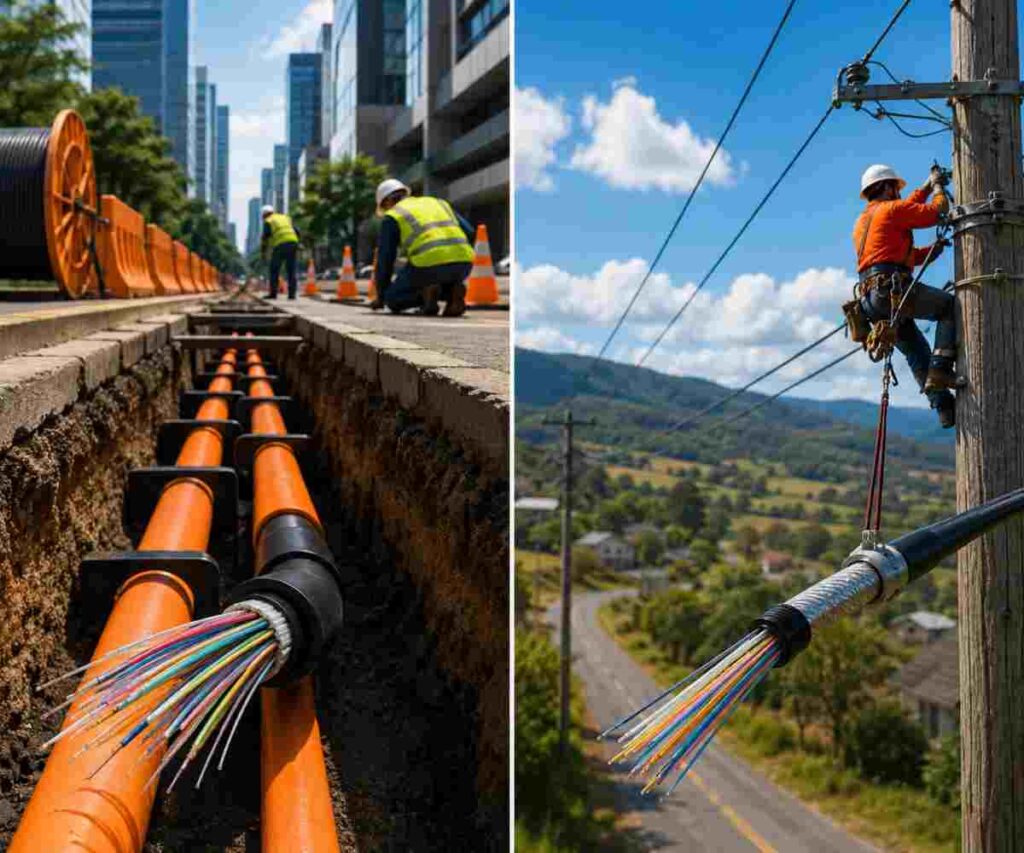
Fiber optic networks are at the forefront of this digital revolution, as the demand for high-speed internet is skyrocketing worldwide. Global IP traffic has surpassed 400 exabytes per month, according to industry estimates, and most of that load is carried by Fiber. Everything, including 5G backhaul, cloud computing, and smart cities, is dependent on a strong Fiber infrastructure.
The problem is that constructing that infrastructure involves more than just installing cables; it also involves deciding how to install them. Should they move underground for protection or overhead for cost savings? This decision can have a 30 to 70% influence on project expenditures, network uptime, and long-term maintenance strategy.
Consider it like building roads: do you invest in more exposed but faster-to-build roadways or tunnels that last decades? Let’s examine both possibilities using real-world examples.
Underground Fiber networks involve installing cables beneath the surface using conduits or direct burial. These are common in dense cities where reliability and aesthetics are critical.
Take cities like Singapore, for example. Over 90% of its Fiber infrastructure is underground, supporting one of the fastest internet ecosystems globally. This approach ensures minimal disruption from tropical storms and urban congestion.
Another example is metro rail communication systems, where Fiber is always routed underground for safety and uninterrupted operations. These networks often achieve uptime levels above 99.99%, making them ideal for mission-critical applications.
You may also like: “Trends in Outsourcing Fiber Optic Cable Planning and Design Services”
Aerial Fiber networks are mounted on utility poles and are widely used in suburban and rural areas. They are especially popular in countries like United States, where approximately 60% of rural Fiber deployments are aerial due to cost advantages.
A good example is broadband expansion projects under government programs like the Rural Digital Opportunity Fund (RDOF). Service providers often choose aerial deployment to cover large distances quickly and economically.
In developing regions, aerial Fiber has enabled connectivity rollouts in record time. Some projects report deployment speeds up to 3x faster compared to underground methods.
Underground Fiber networks are known for their durability and resilience. Studies show that underground systems experience 30–50% fewer outages compared to aerial networks, primarily because they are protected from environmental factors like wind, ice, and falling trees.
Another major benefit is reduced maintenance frequency. While repairs can be complex, they are needed less often. In urban business districts, downtime costs can exceed $5,000 per minute, making reliability a top priority—this is where underground Fiber shines.
Additionally, underground systems offer better protection against accidental damage. In regions prone to storms or cyclones, underground Fiber can maintain connectivity even when power lines are down. This is why financial hubs and data centers heavily rely on buried Fiber infrastructure.
The biggest drawback? Cost. Installing underground Fiber can range from $25,000 to $100,000 per mile, depending on terrain and urban density. In contrast, aerial deployment can cost as low as $10,000 to $30,000 per mile.
Urban areas add another layer of complexity. Excavation permits, traffic management, and utility coordination can increase project timelines by 20–40%. Maintenance is also more expensive—fault detection and repair may take hours or even days due to the need for digging.
There’s also the risk of accidental cuts during construction. Reports suggest that over 25% of Fiber outages in urban areas are caused by third-party digging activities, which can impact even well-protected underground networks.
Aerial Fiber networks are the go-to choice when speed and budget matter. Installation costs are typically 40–60% lower than underground systems, making them ideal for large-scale rollouts.
Deployment speed is another major advantage. Crews can install 1–2 miles of aerial Fiber per day, compared to significantly slower underground trenching rates. This makes aerial networks perfect for rapid expansion projects, especially in underserved areas.
Maintenance is also simpler and cheaper. Faults can be identified visually and repaired quickly, reducing downtime. In many cases, service restoration can happen within a few hours, compared to longer repair cycles for underground systems.
Aerial Fiber networks are more vulnerable to environmental damage. Studies indicate that weather-related incidents account for nearly 40% of aerial Fiber outages, including storms, high winds, and ice accumulation.
Another issue is physical damage. Vehicle collisions with poles, animal interference, and even vandalism can disrupt service. In cyclone-prone regions, aerial networks often experience higher failure rates during extreme weather events.
There’s also the aesthetic concern. Overhead cables can clutter cityscapes, leading many urban planners to restrict aerial installations. Additionally, pole-sharing agreements can complicate deployment, especially when multiple telecom providers are involved.
|
Factor |
Underground Fiber |
Aerial Fiber |
|
Installation Cost per Mile |
$25K–$100K |
$10K–$30K |
|
Deployment Speed |
Slow |
Fast (up to 3x faster) |
|
Outage Rate |
Low (30–50% fewer outages) |
Higher |
|
Maintenance Complexity |
High |
Moderate |
|
Weather Impact |
Minimal |
High |
|
Lifespan |
25–40 years |
15–25 years |
The decision between underground and aerial Fiber depends on multiple factors. Urban environments with high data demand and strict aesthetic requirements often favor underground systems. Rural and suburban areas, on the other hand, benefit from the cost efficiency and speed of aerial deployment.
In many modern projects, a hybrid approach is used. Critical zones like business districts and data centers use underground Fiber, while less sensitive areas rely on aerial networks. This strategy balances cost, performance, and scalability effectively.x
Designing Fiber networks is all about trade-offs. Underground Fiber networks offer unmatched reliability and protection, making them ideal for critical infrastructure and urban environments where uptime is essential. Aerial Fiber networks, on the other hand, provide faster and more cost-effective deployment, especially for large-scale rural and suburban expansion projects.
By understanding the statistics, real-world examples, and practical challenges of each approach, businesses and telecom providers can make informed decisions that align with their project goals, budget, and long-term performance requirements. Whether you’re planning a smart city, expanding broadband connectivity, or strengthening telecom infrastructure, selecting the right Fiber deployment method will shape network efficiency for decades.
At ASE Structure Design, we specialize in reliable telecom and Fiber network design solutions, helping clients build scalable, efficient, and future-ready infrastructure tailored to evolving connectivity demands.
You may also like: “Unlocking the Potential of Home Fiber Connections”
Underground fiber networks install cables below the surface using conduits or direct burial, while aerial fiber networks are mounted on utility poles. Underground systems offer better protection and reliability, whereas aerial systems are faster and cheaper to deploy.
Aerial fiber is generally more cost-effective, with installation costs ranging from $10,000–$30,000 per mile, compared to $25,000–$100,000 per mile for underground fiber networks.
Underground fiber networks are protected from weather events such as storms, wind, and falling trees, leading to fewer outages and more stable network performance.
Underground Fiber is widely used in urban areas, business districts, smart cities, metro rail systems, and data center connectivity where uptime and aesthetics are important.
Underground fiber networks typically last 25–40 years, while aerial fiber networks usually have a lifespan of 15–25 years, depending on environmental conditions.
Underground fiber networks are generally better for cyclone-, storm-, or harsh weather-prone areas because they are less exposed to environmental damage.
Smart cities usually prefer underground fiber networks due to their reliability, cleaner appearance, and ability to support high-capacity digital infrastructure.
WhatsApp Us