
FTTH Design Best Practices for High-Speed Connectivity
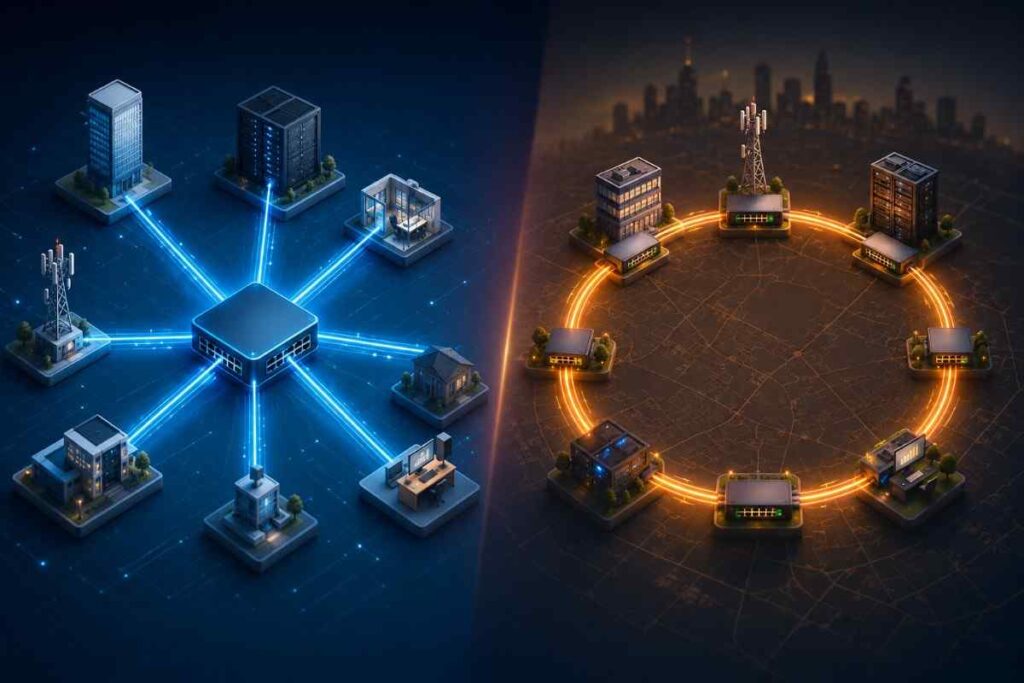
Fiber optic networks are the backbone of modern digital communication. From telecom towers and data centers to enterprise connectivity and broadband services, the design of Fiber networks directly impacts performance, reliability, and scalability. One of the most critical decisions in Fiber network planning is choosing the right topology.
Two of the most used Fiber network topologies are Star Topology and Ring Topology. Each has its own advantages, limitations, and ideal use cases depending on the network architecture and operational requirements.
In this article, we will explore the differences between Ring vs Star Topology in Fiber Network Design, including their structures, advantages, disadvantages, and why many modern telecom networks increasingly prefer the Star Topology model.
Star topology is a network design where all nodes are connected to a central hub, switch, or distribution point through dedicated Fiber links. Instead of devices being connected to each other, every node communicates through a central connection point.
This topology is widely used in telecommunication networks, enterprise Fiber networks, and data center connectivity because of its simplicity and efficient management.
In a Fiber star network:
This model ensures that each connection is independent, improving network performance and troubleshooting. This topology is widely used in Fiber-to-the-home (FTTH), enterprise networks, and telecom backbone infrastructure.
You may also like: “Trends in Outsourcing Fiber Optic Cable Planning and Design Services”
In a star network, failure of one Fiber link only affects a single node, not the entire network. This isolation significantly improves overall network reliability.
Since every connection is independent, identifying and resolving network faults becomes much easier. Engineers can quickly trace problems back to specific Fiber links or nodes.
Because each node has a dedicated connection, bandwidth is not shared across multiple nodes like in some other topologies. This ensures faster and more stable data transmission.
Star networks are highly scalable. New nodes can be added simply by connecting them to the central hub without affecting existing connections.
With centralized control, network monitoring and configuration become easier for network administrators and telecom engineers.
The biggest drawback of star topology is that the entire network depends on the central hub or switch. If this device fails, communication across the network may stop.
Since every node requires a dedicated Fiber cable to the central hub, this topology often requires more Fiber cabling compared to other designs.
Initial deployment costs can be higher due to additional Fiber cables, switches, and centralized infrastructure.
Ring topology is a network design where each node connects to two other nodes, forming a circular data path. Data travels around the ring until it reaches the intended destination.
This topology was widely used in early telecom transport networks and metro Fiber rings, especially for redundancy and loop-based communication systems.
In a ring network:
Ring topology is commonly used in:
Some advanced Fiber rings use dual-ring architectures to provide redundancy if one link fails.
Because data travels in a predefined circular path, network traffic flow becomes more predictable.
Each node receives equal opportunity to transmit data since communication passes through every node.
Ring topology has historically been used in metropolitan area networks (MANs) because it can connect multiple sites along a circular route.
Modern Fiber rings often use dual rings that allow data to travel in the opposite direction if one Fiber link fails.
If a single node or Fiber link fails in a single-ring system, it can disrupt the entire network communication.
Since nodes are interconnected, diagnosing faults becomes more complex compared to star networks
Adding new nodes often requires temporary shutdown or reconfiguration of the ring structure.
Data must pass through multiple nodes before reaching its destination, which may increase latency in large networks.
In modern Fiber infrastructure, star topology is often preferred over ring topology, especially in telecom tower backhaul networks and enterprise connectivity.
Here are some reasons why:
Star networks allow engineers to immediately detect which link has failed. In ring networks, failures can propagate through the entire loop.
Adding new nodes in star networks is easier and does not disrupt the entire network structure.
Dedicated links in star topology reduce congestion and improve bandwidth availability.
Telecom operators and network engineers find star networks easier to maintain due to centralized architecture.
With the growth of 5G networks, telecom towers, and fiber backhaul, star topology aligns better with modern high-capacity network demands.
Feature | Star Topology | Ring Topology |
Network Structure | Central hub with connected nodes | Circular loop connection |
Data Flow | Through central node | Around the ring |
Fault Impact | Affects only one node | May affect entire network |
Troubleshooting | Easy | Complex |
Scalability | Highly scalable | Difficult to expand |
Fiber Requirement | Higher | Lower |
Performance | High | Moderate |
Network Management | Centralized | Distributed |
Choosing the right topology is crucial for designing an efficient and reliable Fiber optic network. Both Star Topology and Ring Topology have their own strengths and limitations.
Ring topology was widely used in traditional telecom transport networks because of its loop structure and redundancy capabilities. However, with the increasing demand for high-speed data transmission, scalable infrastructure, and simplified network management, star topology has become the preferred choice for many modern Fiber networks.
Its ability to provide dedicated connections, easier troubleshooting, better scalability, and improved performance makes it ideal for telecom operators, enterprise networks, and data-driven infrastructure.
As Fiber networks continue to expand globally—supporting everything from 5G towers to smart cities and cloud data centers—the role of efficient network design becomes even more critical.
Companies specializing in telecom infrastructure design, such as ASE Structure Design, support telecom operators and engineering firms with high-quality structural and infrastructure design solutions that enable reliable deployment of telecom towers and network connectivity systems.
Proper planning, engineering expertise, and optimized network topology are essential to building the next generation of resilient Fiber networks.
You may also like: “Unlocking the Potential of Home Fiber Connections”
The main difference is network structure. In Star topology, all nodes connect to a central hub through dedicated Fiber links, while in Ring topology, nodes connect in a circular loop where data travels between neighboring nodes.
Star topology is often preferred for modern Fiber networks because it offers easier troubleshooting, better scalability, improved performance, and faster fault isolation.
Star topology provides dedicated connections to each node, reducing congestion and making network management easier. It is commonly used in telecom towers, enterprise Fiber networks, and FTTH deployments.
Ring topology offers predictable data flow, equal access to network resources, and redundancy in dual-ring systems. It has traditionally been used in metro Fiber and telecom transport networks.
In single-ring systems, failure of one Fiber link or node can disrupt the entire network, making fault management more difficult.
Star topology is more scalable because new nodes can be added easily without disrupting existing network connections.
A well-designed topology ensures stable connectivity, reliable performance, easier maintenance, and efficient data transmission across telecom and enterprise networks.
WhatsApp Us