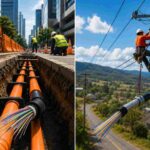
Designing Underground vs Aerial Fiber Networks: Pros & Cons

Imagine your internet connection as a highway. Traditional copper cables are like congested city roads—slow, noisy, and prone to breakdowns. Fiber to the Home (FTTH), on the other hand, is a multi-lane expressway built for speed, efficiency, and future expansion. It uses Fiber-optic cables to deliver high-speed internet directly to homes, enabling lightning-fast data transmission with minimal latency.
At its core, FTTH replaces legacy infrastructure like DSL or coaxial systems with pure optical Fiber, ensuring consistent performance even during peak usage. Unlike copper, Fiber transmits data as light, making it immune to electromagnetic interference and signal degradation over long distances. This makes it the backbone of modern digital ecosystems—from streaming and gaming to smart homes and remote work.
The importance of FTTH has surged in recent years due to growing bandwidth demands. Think about it—4K streaming, cloud computing, IoT devices, and AI-driven applications all require robust connectivity. Without Fiber, these technologies simply can’t perform at their best. FTTH isn’t just an upgrade; it’s a necessity for future-ready infrastructure.
The expansion of FTTH networks is nothing short of explosive. Recent industry data show that Fiber networks have passed over 98 million homes in the U.S. alone by 2025, covering more than 60% of households. Even more compelling, adoption rates have climbed to nearly 46.5%, proving that users prefer Fiber over traditional broadband options.
Globally, the trend is just as strong. Fiber is rapidly becoming the dominant broadband technology, with projections suggesting it could lead the fixed internet market by 2028. This surge is fueled by increasing digital consumption, government funding, and the need for ultra-reliable connectivity.
Why does this matter for design? Because rapid adoption means networks must be built not just for today’s needs but for tomorrow’s exponential growth. Poor planning can lead to costly upgrades, bottlenecks, and dissatisfied users. That’s why understanding FTTH design best practices is critical for engineers, telecom companies, and infrastructure planners aiming to deliver seamless, high-speed connectivity.
You may also like: “Trends in Outsourcing Fiber Optic Cable Planning and Design Services”
The Home Run architecture is often considered the gold standard for FTTH design. In this model, each subscriber is connected directly to the central office using a dedicated Fiber line. Think of it as giving every home its own private highway lane—no sharing, no congestion.
This architecture offers unmatched bandwidth and flexibility. Since there are no intermediate splitters, each user receives maximum signal strength and can easily upgrade speeds without major infrastructure changes. It’s ideal for densely populated urban areas where high performance is a priority.
However, nothing comes without a trade-off. Home Run networks require extensive Fiber deployment, making them the most expensive option in terms of materials and labor . Installation is also more complex, requiring larger ducts and more splicing work. Still, for long-term scalability and premium service delivery, many operators consider it worth the investment.
The Centralized Split architecture strikes a balance between performance and cost. Instead of running individual Fibers to each home, a central splitter distributes signals from a single Fiber to multiple users.
This approach reduces the amount of Fiber needed, lowering deployment costs while maintaining good performance. It’s widely used in urban and suburban environments where density allows for efficient signal distribution.
One major advantage is flexibility. Operators can adjust split ratios and upgrade technologies without redesigning the entire network. However, centralized systems rely heavily on cabinets and distribution points, which can become bottlenecks if not properly managed.
The Distributed Split architecture takes efficiency a step further by placing splitters closer to end users. This reduces feeder Fiber requirements and allows for more flexible network layouts.
It’s particularly useful in smaller towns or semi-urban areas where population density varies. By distributing splitters, operators can optimize resource usage and reduce costs.
The downside? Troubleshooting becomes more complex since splitters are spread across multiple locations. Maintenance teams need to manage multiple access points, which can increase operational challenges.
Designed for rural and sparsely populated areas, the Optical Tap architecture minimizes Fiber usage by connecting subscribers sequentially along a single line. It’s like a bus route where each stop represents a home.
This approach is cost-effective and efficient for low-density regions. However, it requires precise planning to ensure signal strength remains adequate for all users. Any disruption along the line can affect multiple subscribers, making reliability a key concern.
Every successful FTTH project begins with a thorough site survey. Skipping this step is like building a house without checking the foundation—it’s bound to cause problems later.
Engineers must analyse factors such as population density, terrain, existing infrastructure, and future growth potential. Demand forecasting is equally important. How many users will connect? What bandwidth will they require? These questions shape the entire design process.
Accurate data ensures efficient resource allocation and prevents overbuilding or under-provisioning. It also helps identify potential challenges early, saving time and money during deployment.
Choosing the right topology is one of the most critical decisions in FTTH design. Each architecture—Home Run, Centralized, Distributed, or Optical Tap—has its own advantages and limitations.
The choice depends on factors like cost, scalability, and geographic conditions. Urban areas may benefit from centralized or home run designs, while rural regions often require optical tap solutions.
A well-chosen topology ensures optimal performance, easier maintenance, and long-term sustainability.
Designing for today is easy. Designing for the next decade? That’s where expertise comes in.
Capacity planning involves anticipating future demand and ensuring the network can handle it without major upgrades. This includes adding spare Fibers, choosing scalable equipment, and planning for technological advancements.
Fiber networks are known for their “virtually limitless bandwidth,” meaning upgrades often require only equipment changes rather than new cables. Smart planning leverages this advantage to create future-proof networks.
Efficient routing is the backbone of any FTTH network. Poor routing increases costs, delays deployment, and complicates maintenance.
Designers should aim for the shortest, most direct paths while avoiding obstacles and minimizing bends. Advanced tools like GIS mapping can help identify optimal routes and reduce installation complexity.
Signal loss is the silent enemy of high-speed connectivity. Every splice, connector, and bend introduces attenuation, reducing signal strength.
Best practices include using high-quality components, minimizing splices, and maintaining proper bend radii. Regular testing ensures the network performs as expected.
Splitters play a crucial role in FTTH networks, especially in PON (Passive Optical Network) systems. Choosing the right split ratio is essential for balancing performance and cost.
Too many splits can weaken the signal, while too few increase infrastructure costs. The key is finding the sweet spot that delivers reliable performance without overspending.
What happens when a Fiber line is cut? Without redundancy, users lose connectivity instantly.
Incorporating backup paths and redundant components ensures uninterrupted service. While it may increase initial costs, it significantly improves reliability and customer satisfaction.
Modern FTTH design relies heavily on GIS tools for planning and visualization. These tools provide detailed insights into terrain, infrastructure, and demand patterns.
By integrating GIS data, designers can create accurate, efficient network layouts that reduce errors and improve deployment speed.
Pre-terminated cables are gaining popularity due to their ease of installation and reduced labor requirements. They minimize errors and speed up deployment.
Spliced Fiber, on the other hand, offers greater flexibility and customization. The choice depends on project requirements, budget, and deployment timeline.
Every design decision involves a trade-off between cost and performance. High-performance architectures like Home Run offer superior speed but come at a higher cost.
Balancing these factors requires careful planning and a clear understanding of project goals.
Urban areas benefit from high population density, making FTTH deployment more cost-effective. Rural regions, however, present challenges such as longer distances and lower return on investment.
Innovative designs and government support are essential for bridging this gap.
AI is transforming FTTH design by automating planning, optimizing routes, and predicting demand. This reduces human error and accelerates deployment.
Sustainable practices, such as using eco-friendly materials and minimizing waste, are becoming increasingly important. Efficient designs not only reduce costs but also environmental impact.
FTTH design is more than just deploying Fiber cables—it is about creating a reliable, scalable, and future-ready digital infrastructure that supports growing connectivity demands. As businesses, communities, and smart technologies increasingly depend on uninterrupted high-speed internet, following proven FTTH design best practices becomes essential for long-term performance and efficiency.
From selecting the right network architecture and optimizing Fiber routing to ensuring minimal signal loss and scalability, every stage of FTTH planning plays a critical role in delivering seamless connectivity. A well-designed Fiber network not only improves user experience but also reduces operational challenges and future upgrade costs.
At ASE Structure Design, we understand the importance of precision-driven telecom and Fiber network engineering. With expertise in telecom infrastructure design, OSP Fiber planning, and CAD-based engineering solutions, we help build robust and efficient Fiber networks designed to meet today’s needs while preparing for tomorrow’s digital growth.
You may also like: “Unlocking the Potential of Home Fiber Connections”
Fiber to the Home (FTTH) is a Fiber-optic communication system that delivers high-speed internet directly to homes using optical Fiber cables instead of traditional copper networks.
FTTH provides faster internet speeds, lower latency, better reliability, and higher bandwidth capacity, making it ideal for streaming, remote work, smart homes, and cloud-based applications.
The main FTTH architectures include Home Run, Centralized Split, Distributed Split, and Optical Tap. Each architecture is selected based on factors such as cost, population density, scalability, and geographic conditions.
The right FTTH architecture depends on user density, terrain, budget, performance requirements, and future expansion needs. Urban areas often use centralized models, while rural areas may benefit from optical tap designs.
WhatsApp Us